NVIDIA Acquires Hugging Face for $12.93B: Developer Impact
The artificial intelligence industry just experienced its biggest structural shift since the launch of ChatGPT. NVIDIA has officially agreed to acquire Hugging Face, the undisputed center of the open-source AI community, in a transaction valued at $12.93 billion. For developers who build, fine-tune, and deploy models daily, this deal brings massive computational scale directly to open-source workflows while raising immediate questions about platform neutrality.
The Mechanics Behind the $12.93 Billion Deal
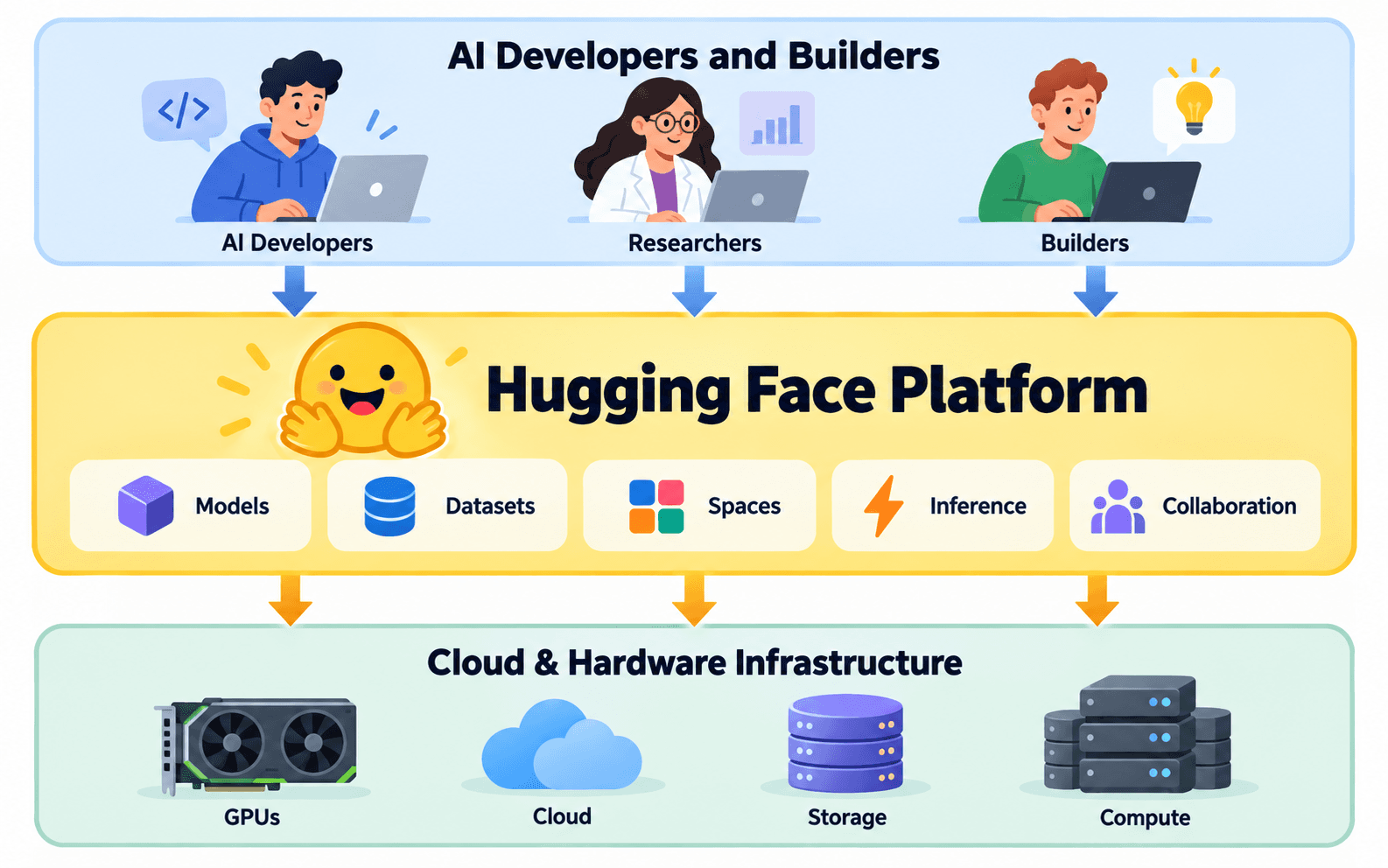
o understand why NVIDIA paid a premium for Hugging Face, you have to look at the current AI infrastructure stack. NVIDIA already dominates hardware with its Graphics Processing Units (GPUs)—specialized microprocessors optimized for parallel vector math. However, hardware is only half the battle; owning the developer workflow layer ensures that every model built today defaults to your hardware tomorrow.
Hugging Face built the de facto standard platform for open-source machine learning. Its Model Hub hosts over one million open models, including Meta’s Llama series, Mistral, and Stability AI assets. Millions of engineers use their Transformers library—a Python framework that simplifies downloading and running pre-trained neural networks—every single day.
By acquiring Hugging Face, NVIDIA bridges the gap between hardware production and software distribution. They are not just selling chips anymore; they now own the digital marketplace where developers discover, test, and host the code running on those chips.
Takeaway: NVIDIA acquired Hugging Face to capture the primary software entry point for open-source AI developers.
What This Means for Open-Source Machine Learning
Open-source AI relies heavily on neutrality to flourish. Developers use Hugging Face because it allows seamless execution across diverse environments, whether you are running code on local consumer hardware, Google Cloud TPUs (Tensor Processing Units), or AWS Inferentia chips.
NVIDIA’s leadership has publicly stated that Hugging Face will remain an open ecosystem. However, deep software integration with CUDA—NVIDIA’s proprietary parallel computing platform and API model—is virtually guaranteed. We can expect native optimizations that make running models on NVIDIA hardware faster out-of-the-box compared to competing hardware vendors.
# Before: Standard model pipeline from Hugging Face
from transformers import pipeline

classifier = pipeline("sentiment-analysis")
result = classifier("NVIDIA acquired Hugging Face!")
print(result)
For everyday open-source maintainers, the influx of capital means better hosting performance, faster inference endpoints, and stronger community infrastructure. The key concern remains whether non-NVIDIA hardware acceleration will receive the same level of framework support moving forward.
Takeaway: The acquisition brings speed and resource improvements to open-source models, but risks deepening vendor lock-in to NVIDIA's software stack.
Integrating CUDA, NIM, and the Hugging Face Ecosystem
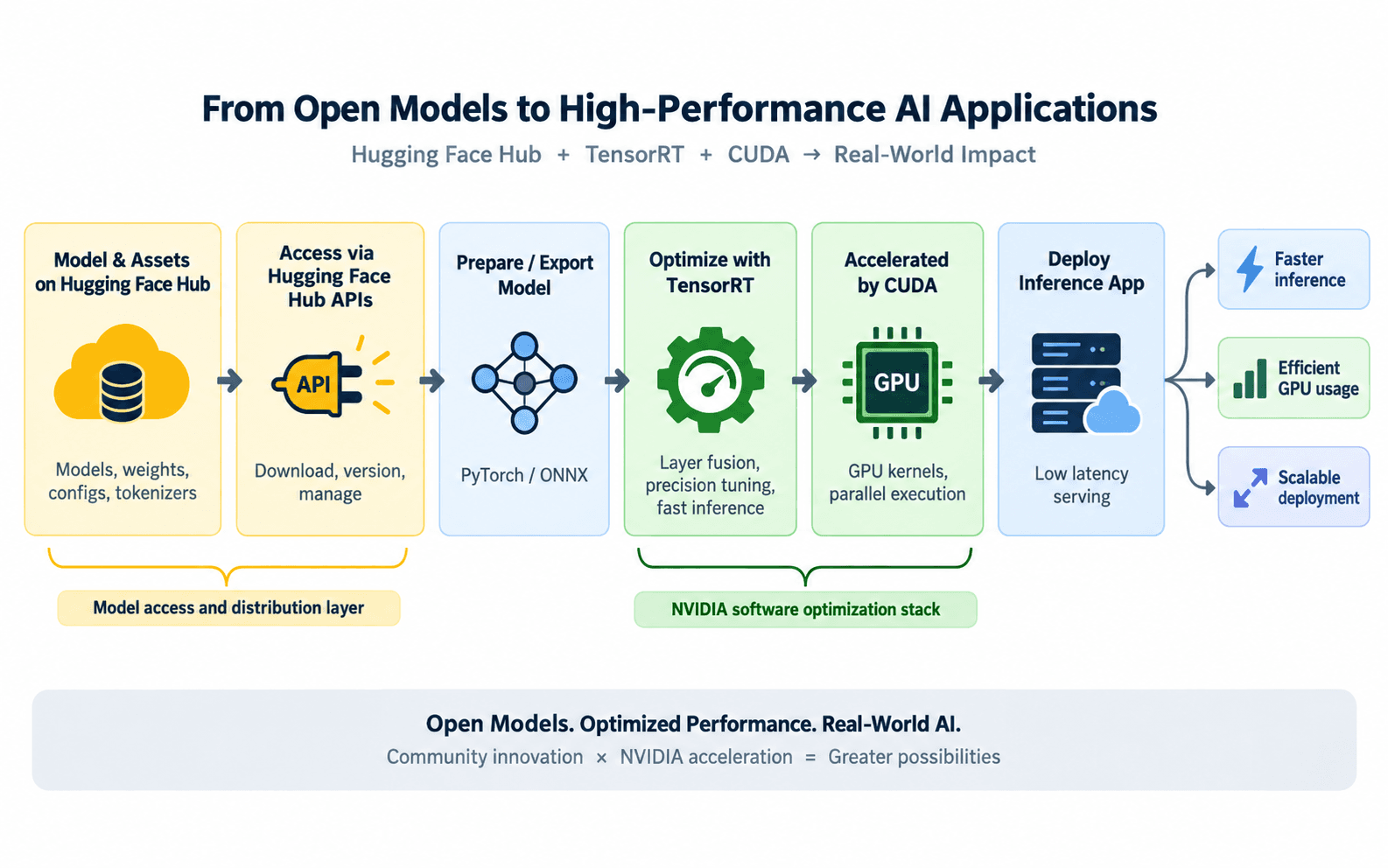
The technical synergy between both companies lies directly within the deployment pipeline. NVIDIA has been heavily pushing NIM (NVIDIA Inference Microservices), a set of pre-built cloud-native containers that optimize model execution using TensorRT-LLM—a library specifically designed to accelerate Large Language Model inference on NVIDIA GPUs.
Currently, developers often struggle with quantization—the process of reducing model weight precision from 16-bit floats to 8-bit or 4-bit integers to reduce memory footprint. Integrating these low-level optimizations natively into Hugging Face’s transformers and peft (Parameter-Efficient Fine-Tuning) libraries will eliminate significant setup friction.
# Future vision: Direct hardware-accelerated quantization via native integration
from transformers import AutoModelForCausalLM

model = AutoModelForCausalLM.from_pretrained(
    "meta-llama/Llama-3-8B",
    engine="nvidia-nim",      # Theoretical native runtime integration
    precision="fp4_quant"
)
Instead of spending hours writing custom optimization scripts for server deployment, engineers will soon be able to deploy optimized models to production with a single parameter. This deep integration makes high-performance model hosting accessible to individual developers without requiring specialized low-level systems expertise.
Takeaway: Developers will gain access to automated, high-performance model optimizations directly inside standard Hugging Face libraries.
The Competitive Landscape: AMD, Cloud Providers, and Monopolization
This acquisition sends shockwaves through NVIDIA's primary competitors. AMD has made steady progress in supporting PyTorch and Hugging Face via ROCm—their open-source software stack for GPU computing. If NVIDIA prioritizes CUDA acceleration within Hugging Face libraries, AMD may need to invest heavily in alternative open hubs or double down on its own developer tooling.
Major cloud providers like Amazon Web Services and Google Cloud also face a shifting landscape. While they host massive amounts of NVIDIA hardware, Hugging Face Spaces—a service for hosting lightweight AI apps—directly competes with basic cloud hosting offerings for early-stage prototypes.
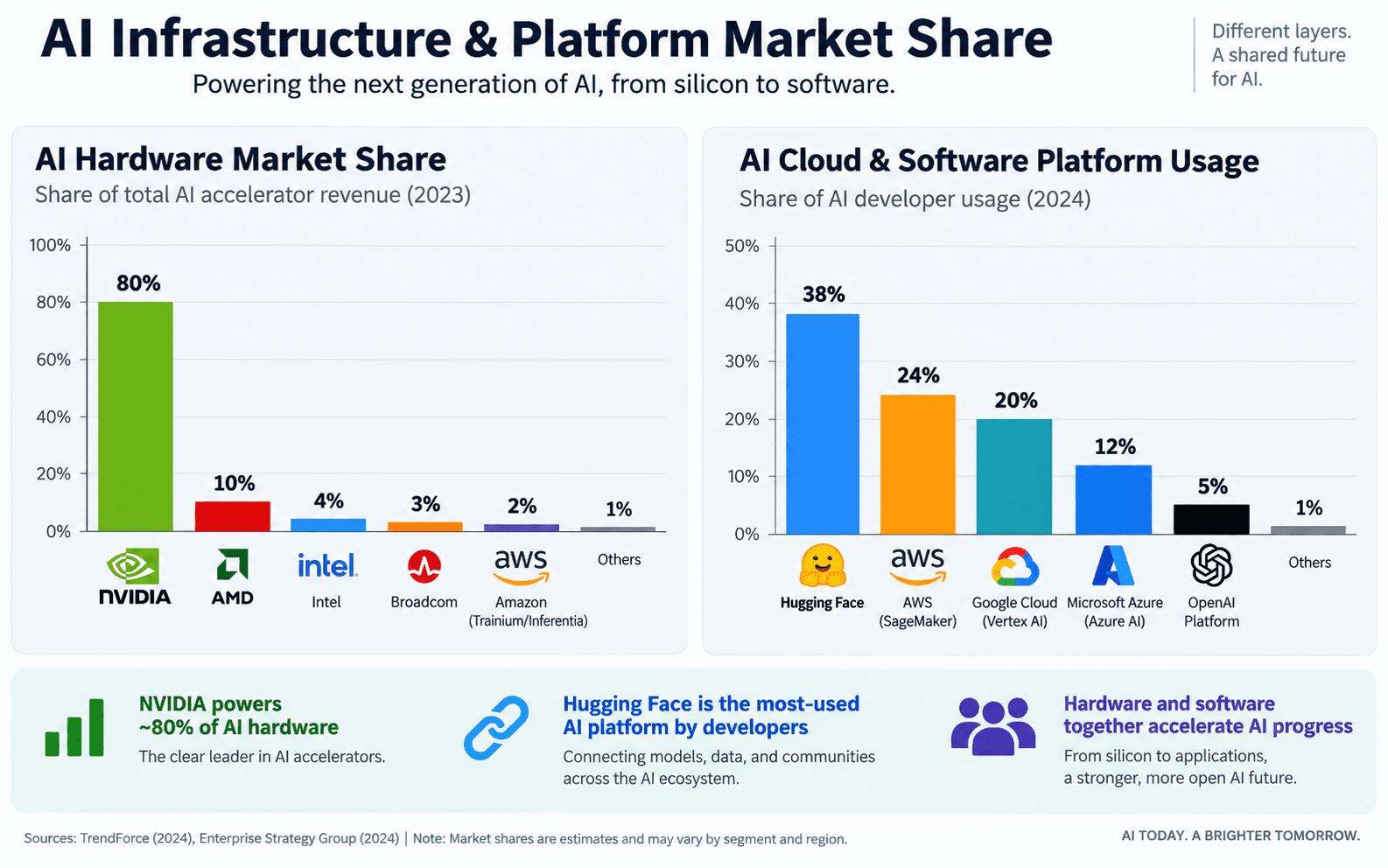
Regulatory scrutiny will inevitably follow this announcement. Antitrust agencies in the US and EU will examine whether owning both the hardware market and the dominant model marketplace restricts fair competition for alternative AI hardware startups.
Takeaway: Competitors will be forced to build alternative software distributions to avoid complete reliance on an NVIDIA-owned platform.
Final Thoughts
NVIDIA acquiring Hugging Face for $12.93 billion marks the end of the initial rapid-growth phase of open-source AI and the beginning of the enterprise integration era. For full-stack developers, this deal promises faster tools, simpler deployment workflows, and tighter integration between models and hardware. While the loss of neutral ownership raises valid long-term questions, the immediate technical benefits for developers building on NVIDIA hardware will be substantial.